
An international-standard training cooperation model between the University of Transport and Communications and Chisholm Institute (Australia)
Bachelor of Engineering Technology Program – A Training Cooperation Model between the University of Transport and Communications (UTC) and Chisholm Institute (Australia)
The program is designed under a 2+2 study pathway, with two years of study at UTC and two years at Chisholm Institute. Through this cooperation model, students have opportunities to undertake internships and develop their careers in an international-standard learning and professional environment.
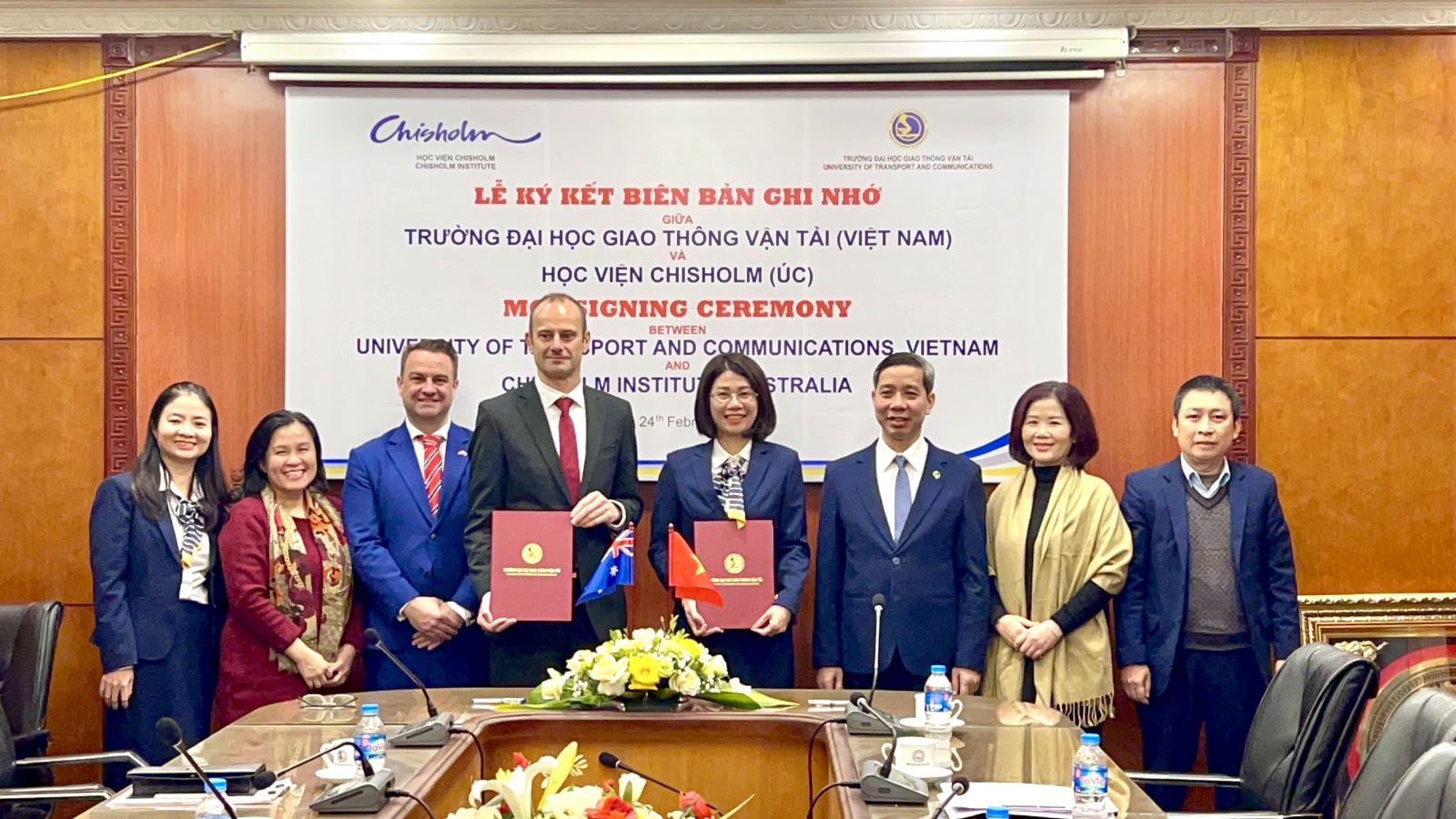
Signing Ceremony of the Cooperation Agreement between the University of Transport and Communications and Chisholm Institute
Future engineers need more than just the ability to operate machines...
Robots, sensors, artificial intelligence, and data are transforming the way factories are designed and operated. Equipment is increasingly connected to control software and management systems. As a result, engineers need not only to understand machinery but also to integrate systems, identify problems, and adapt to emerging technologies.
These requirements are closely aligned with the spirit of Resolution No. 57-NQ/TW on the development of science and technology, innovation, and digital transformation. STEM education, therefore, should go beyond providing technical knowledge. It must also foster systems thinking, problem-solving skills, proficiency in digital tools, and the ability to work in an international environment.
Responding to these practical needs, the University of Transport and Communications (UTC) and Chisholm Institute, Victoria, Australia, are collaborating to deliver an international joint bachelor's degree program in Engineering Technology, with two areas of specialization: Mechatronics and Mechanical Engineering and Manufacturing.
A Learning Model Connected to Modern Industry
Mechatronics integrates mechanical engineering, electrical and electronic engineering, control systems, and software to create robots, automated equipment, and smart manufacturing systems. Students are introduced to an integrated approach that brings together mechanical structures, sensors, controllers, and operating programs.
Mechanical Engineering and Manufacturing focuses on product design, materials, manufacturing technologies, production management, and quality control. Technologies such as CAD/CAM, engineering simulation, and digital manufacturing are transforming the entire process from product design to production.
These two areas of specialization open opportunities for students to pursue careers in fields such as automation, robotics, smart manufacturing, product development, and production-line optimization. These are areas that require engineers who possess a strong technical foundation while also being able to continuously learn and collaborate across disciplines.
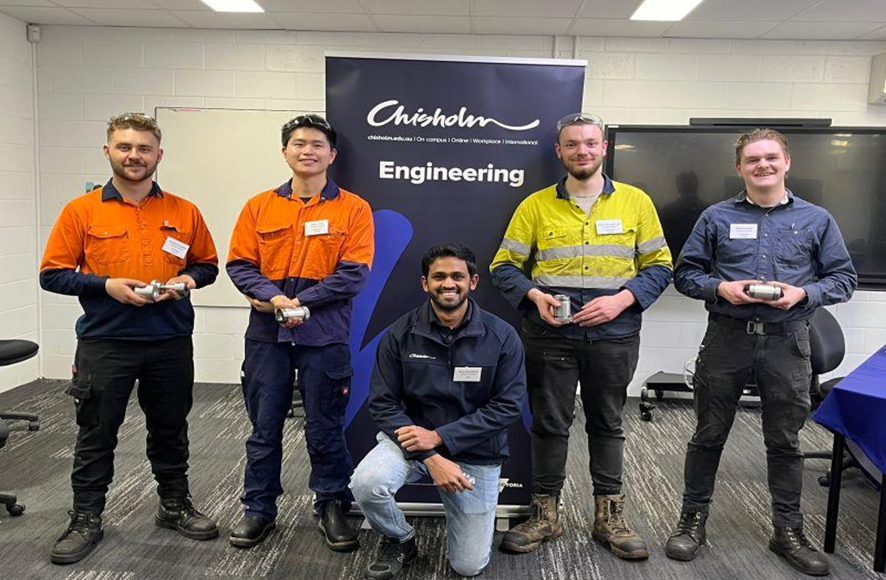
International students studying in the Engineering Technology program at Chisholm Institute. Source: Chisholm.edu.au.
Combining UTC’s strong engineering foundation with applied education at Chisholm
The University of Transport and Communications (UTC) has more than 25,000 students and strong expertise in transportation, infrastructure, mechanical engineering, automation, logistics, and digital technologies. At UTC, students build a foundation in general knowledge and core engineering subjects, develop practical skills, become familiar with university-level learning methods, and strengthen their English proficiency. Laboratory work, capstone projects, and academic projects enable students to apply their knowledge to specific real-world problems.
Chisholm Institute is one of the major vocational and applied higher education institutions in Victoria. In the field of engineering, Chisholm offers programs leading to the Bachelor of Engineering Technology degree. Its learning environment places a strong emphasis on practical training, project-based learning, systems design, industrial automation, and advanced manufacturing processes.
Students complete their first two years at UTC and then progress to the specialized phase at Chisholm Institute, subject to meeting the relevant academic, English-language, and administrative requirements. This pathway allows students to establish a solid foundation in Vietnam before transitioning to an internationally oriented learning environment featuring different approaches to teaching, assessment, and teamwork. Upon successful completion of the program, students are awarded the Bachelor of Engineering Technology degree by Chisholm Institute.
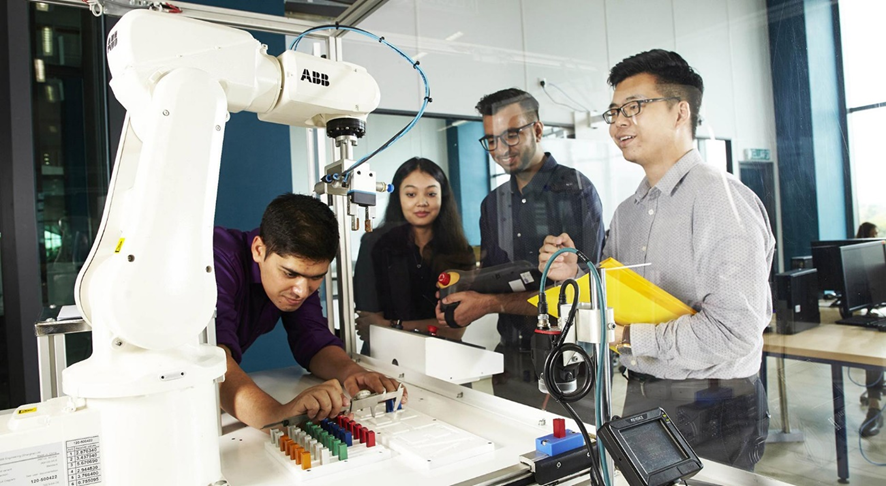
Mechanical engineering practical training at Chisholm Institute. Source: Chisholm.edu.au.
2026 Admissions Information
In 2026, the program will admit students to the Engineering Technology program with two areas of specialization: Mechatronics and Mechanical Engineering and Manufacturing. The first admission round is expected to run from July 1 to July 30, 2026, and the second round from August 1 to September 30, 2026.
The program considers direct admission for eligible applicants who are currently studying at universities in Vietnam or abroad. Applicants with an English proficiency level equivalent to IELTS 5.5 or higher and who meet the academic requirements may be considered for entry into the specialized phase of the program. Specific admission requirements will be implemented in accordance with UTC’s official admissions announcement.
Admissions Consultation Contact
Faculty of International Education – University of Transport and Communications
Room 303, Building B3, No. 3 Cau Giay Street, Lang Ward, Hanoi, Vietnam
Email: ined@utc.edu.vn
Hotlines: 0915 432 768; 0936 062 526; 0988 982 555
Fanpage: facebook.com/inedutc
Website: ined.utc.edu.vn
ICDS
Related Articles
Nearly 200 students from the First Cohort of the Distance Learning Program defend their Graduation Projects in Railway and High-Speed Railway Engineering
DetailTechnical Seminar on “Porous Asphalt Pavements for Highway Projects in Vietnam”
DetailUniversity of Transport and Communications proposes a strategic cooperation model at the Conference of Vietnam’s Seven Leading Engineering and Technology Universities
Detail