
Enhancing Higher Education Quality to foster Hanoi’s Development
On August 20, 2026, the Prime Minister issued Decision No. 1612/QD-TTg, approving the Project on the Development and Enhancement of the Quality of Higher Education Institutions in the Capital.
The Project sets the goal that by 2030, at least two higher education institutions will rank among the top 150 universities in Asia, and at least 12 institutions will serve as leading institutions, including at least six with disciplines or fields ranked among the top 200 in Asia according to reputable international rankings.
The University of Transport and Communications (UTC) is one of the 12 higher education institutions entrusted with a leading role. The Project also emphasizes human resources development, internationalization, infrastructure modernization, digital transformation, and the application of artificial intelligence in university governance, thereby strengthening the connection between higher education with science and technology, innovation, and the development demands of the Capital.
.jpg)
University of Transport and Communications - A Knowledge Hub for Transport, Mobility, and Infrastructure
As a higher education institution designated by the Prime Minister as a key national university, University of Transport and Communications has core strengths in transport engineering, transportation, and infrastructure, supported by a comprehensive interdisciplinary training and research system encompassing planning, surveying, design, construction, operation, management, and maintenance.
Currently, UTC offers 37 undergraduate programs, 13 master programs, and 12 doctoral programs, including 20 programs in basic sciences, key engineering disciplines, and strategic technologies. University has developed specialized programs in high-speed railway, urban railway, railway vehicles, railway electrification, railway control and signaling, and railway transport management, fulfilling demands for highly qualified human resources for major transport infrastructure projects.
UTC’s scientific and technological capabilities are being developed through the integration of engineering with digital technologies, artificial intelligence, big data, BIM, digital twins, simulation, structural health monitoring, electric vehicles, urban logistics, and intelligent transportation. The University of Transport and Communications has the capacity to conduct research, testing, inspection, technical consulting, and technology transfer for large-scale and complex infrastructure projects and transportation systems.
With these strengths, Hanoi and the Capital Region serve as key areas for UTC to link education, research, and technology transfer with practical challenges such as public transportation, urban railway, interregional mobility, bridges, underground infrastructure, logistics, and intelligent traffic management.
From Human Resource Training to Addressing Capital’s Major Challenges
The University of Transport and Communications (UTC) defines its responsibility not only for training human resources for the transport sector but also directly participating in solving the development problems of Hanoi and the Capital Region. Priority training areas include intelligent transportation, control and automation, electrification, artificial intelligence, data science, logistics, and sustainable infrastructure management; promoting interdisciplinary education, customized training programs, industry-based semesters, and integration of academic training with practical projects.
In parallel with training, UTC leverages its role as a knowledge hub through scientific research, policy consulting, and technology transfer with a strong focus on sustainable urban transportation, infrastructure investment efficiency, green transport, emissions reduction, infrastructure asset management, and project risk assessment. Thereby, UTC contributes to enhancing connectivity, developing public transportation, green logistics, and building Hanoi into a smart, green, safe, and sustainable metropolis.
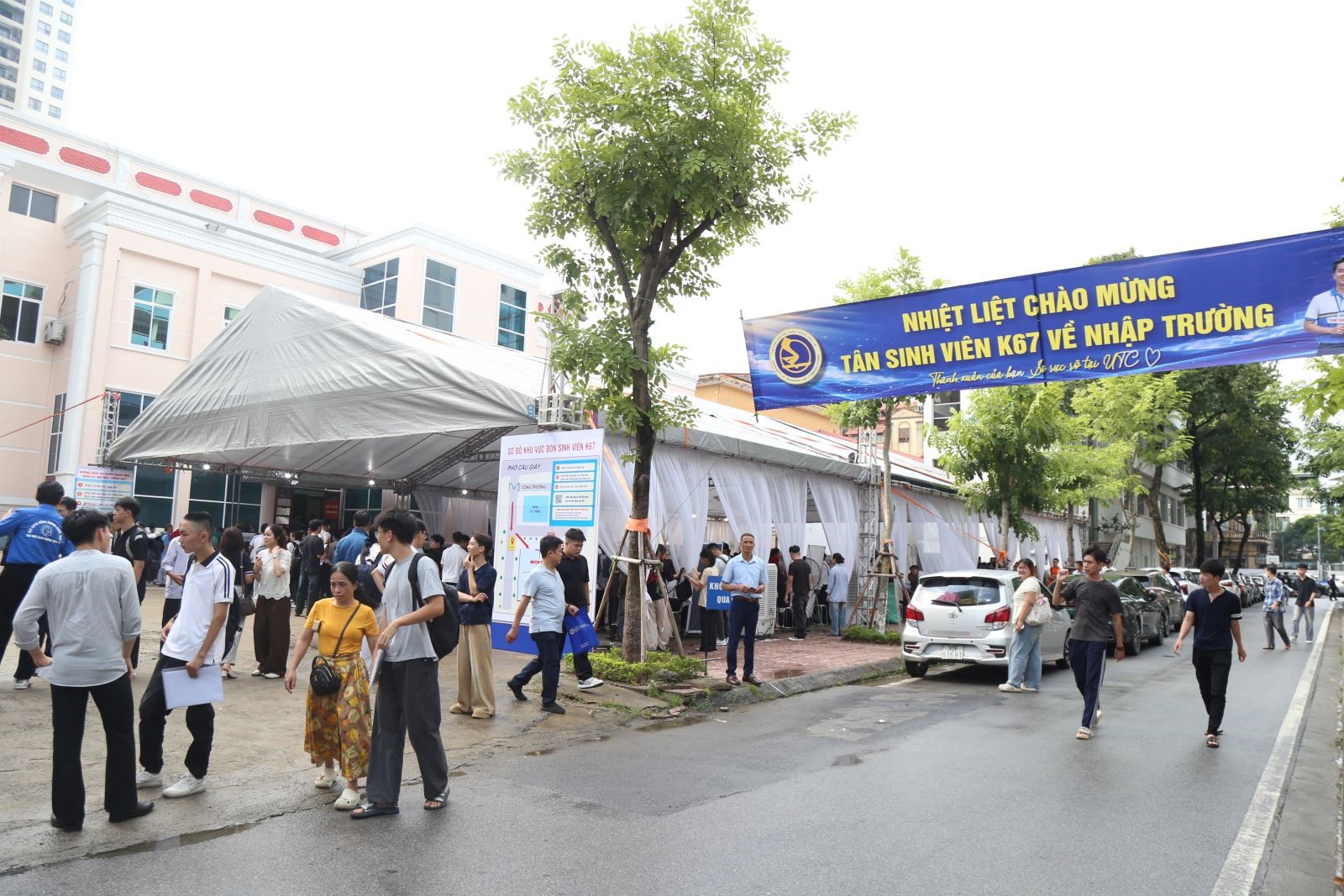
UTC welcomes new students of cohort 67
Toward a Research-Oriented, Smart University with Regional Competitiveness
During the 2026–2030 period, UTC will focus on strengthening its foundations to fulfill a leading role in education and training, scientific research, innovation, and technology transfer in transport, infrastructure, logistics, smart cities, and strategic technologies. In the 2031–2035 period, UTC will accelerate its transition toward a research-oriented, smart, multidisciplinary, and interdisciplinary university with a high degree of autonomy and stronger regional competitiveness.
UTC will continue to improve quality assurance conditions relating to faculty members, finance, libraries, technological infrastructure, laboratories, and the learning environment; modernizing lecture halls, libraries, data centers, simulation centers, and shared laboratory facilities. Priority areas include signaling - control and systems integration; electric power systems and SCADA; intelligent transportation; semiconductors, sensors, and embedded systems; digital twins; advanced materials; bridges; tunnels; geotechnical engineering; and infrastructure safety.
Training activities will be expanded toward elite education, postgraduate studies, and internationalization, including English-taught programs, joint-degree and double-degree programs, co-supervision of doctoral candidates, and international research semesters. Science and technology activities will be oriented toward developing applicable and commercializable products; gradually establishing centers for research, testing, simulation, inspection, and policy consulting in the university's fields of strength.
Affirming important position in the region and contributing to the Capital and National Development
By 2030, the University of Transport and Communications (UTC) aims to become a key national higher education institution in transportation and logistics, taking a leading role in elite education, scientific research, knowledge transfer, and policy consulting. The University strives to rank among the top 200 universities in Asia according to the QS Asia University Rankings and have at least one program or field ranked among the top 200 worldwide according to the QS World University Rankings by Subject or an equivalent ranking.
By 2035, UTC aims to become a leading national and Capital Region center for interdisciplinary education and research, with a strong regional reputation in engineering, technology, infrastructure, and smart urban transportation. The University strives to rank among the top 150 universities in Asia and have at least one academic program or field ranked within the top 150 in prestigious international rankings.
The issuance of Decision No. 1612/QD-TTg by the Prime Minister marks an important milestone, creating an enhanced framework and momentum to improve quality, strengthen research and innovation capabilities, accelerate internationalization, and further fulfill its role as a key national university; making practical contributions to the development of Hanoi as a smart, green, modern and sustainably developed Capital city of Hanoi.
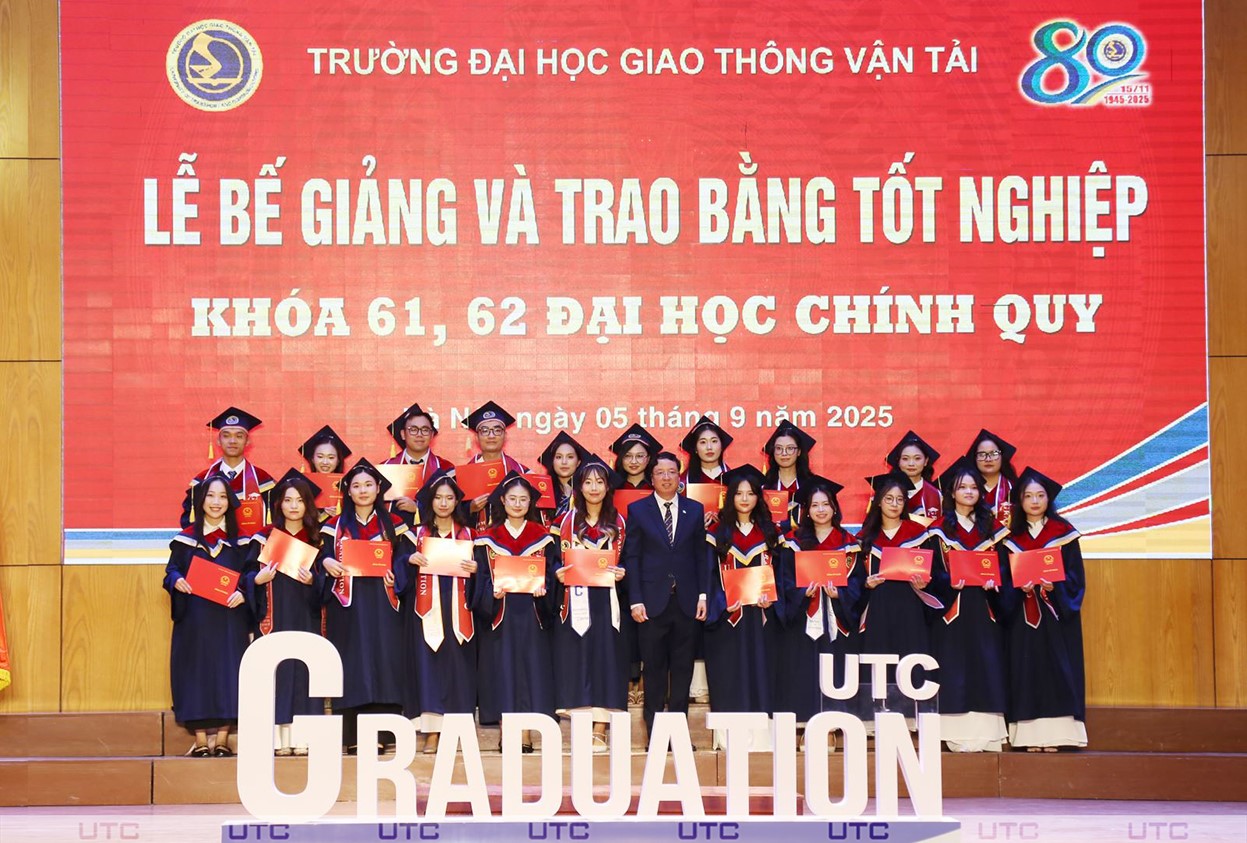
The Graduation Ceremony and Degree Conferral for Cohort 61 and Cohort 62 students
Related Articles
University of Transport and Communications affirms its pioneering role in implementing resolutions No. 57-NQ/TW and No. 71-NQ/TW
DetailUniversity of Transport and Communications welcomes new students of cohort 67
DetailLaunching project on technical solutions for viaduct construction to minimize the use of sand and enhance sustainability in the development of transportation infrastructure in the Mekong Delta Subregion
Detail